
 Book Appointment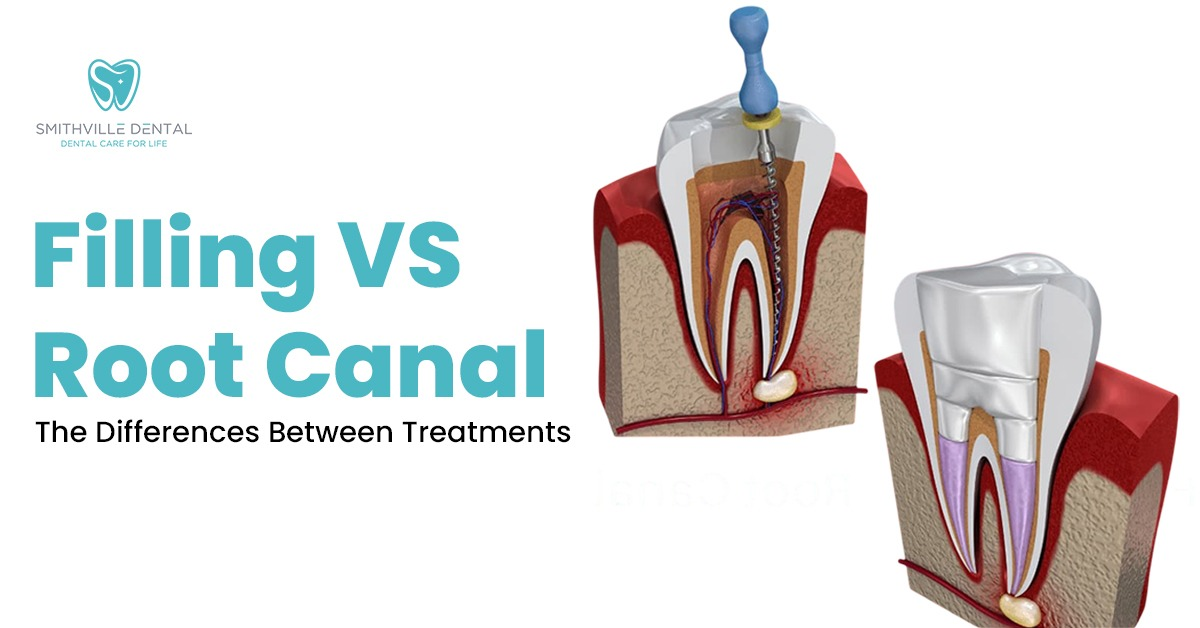
In terms of dental care, knowing the distinction between a root canal and a filling can assist patients in making informed decisions regarding their oral health. Although they treat varying degrees of decay and infection, both procedures aim to heal damaged teeth.
By understanding when each operation is required, natural teeth can be preserved for many years to come and additional difficulties can be avoided. Patients can get the best care for their unique dental needs under the direction of a skilled dentist in Smithville TX.
Understanding Tooth Decay and Cavities
Cavities, which are tiny holes in the enamel caused by oral bacteria producing acids, are the first signs of tooth decay. If treatment is not received, the decay may spread more into the tooth, eventually reaching the dentin & pulp, which is the innermost layer that contains veins and nerves.
The degree of degradation at this point determines the necessary course of treatment. The difference between a root canal vs cavity becomes essential at this point. A root canal is required when the infection has spread to the pulp and has damaged it, but a cavity can frequently be repaired with a straightforward filling.
What Is a Dental Filling?
One of the most popular restorative treatments for tiny cavities or tooth decay involves a dental filling. During the procedure, a dentist removes the tooth’s decaying area and replaces it with a strong substance like porcelain, amalgam or resin made from composite.
Fillings stop more decay while restoring the tooth’s strength, shape and functionality. Usually finished in a single visit, the process is swift and less intrusive. Although healing is nearly instantaneous, patients may feel slight sensitivity later.
When the decay is restricted to the tooth’s outer layers and has not yet impacted the pulp, a filling is the best option. Frequent examinations with a Smithville, Tx dentist can aid in the early detection of cavities, enabling prompt treatment before the damage gets worse.
What Is a Root Canal?
When decay or infection has spread to the tooth’s pulp, a more sophisticated surgery called a root canal is performed. A straightforward filling is no longer adequate in this situation since the infection may result in excruciating pain, swelling or even the development of a disease.
The dentist cleans and disinfects the inner chambers, removes the infected pulp and uses a unique filling material to seal the tooth during a root canal. After that, a crown is placed on the tooth to shield it from further harm.
Although the word “root canal” frequently evokes apprehension, the process is essentially painless thanks to current methods and anaesthesia. It prevents the natural tooth from being extracted in addition to relieving discomfort.
Essential Distinctions Between Filling vs. Root Canal:
- Extent of Decay: Fillings treat minor cavities, while root canals address deep infections that reach the pulp.
- Complexity of Procedure: Root canals are more involved and may need several visits, whereas fillings are quick and easy.
- Pain and Recovery: While root canals cure excruciating pain brought on by illness, fillings produce minimal discomfort.
- Restoration Requirements: Crowns are frequently needed after root canals to provide further protection, while fillings can restore minor regions of deterioration.
Conclusion
Patients can take proactive measures to keep healthy teeth by being aware of the differences between a filling vs root canal. Root canals are necessary to save highly infected teeth, while fillings treat cavities in their early stages. Good oral hygiene and routine dental examinations can stop decay from getting worse to the point where extensive treatment is required.
Patients can count on a reputable dentist in Smithville TX, for professional care and individualised solutions. Smithville Dental guarantees that every patient receives the proper care to restore their smile and safeguard their oral health with compassionate care and innovative dental methods.